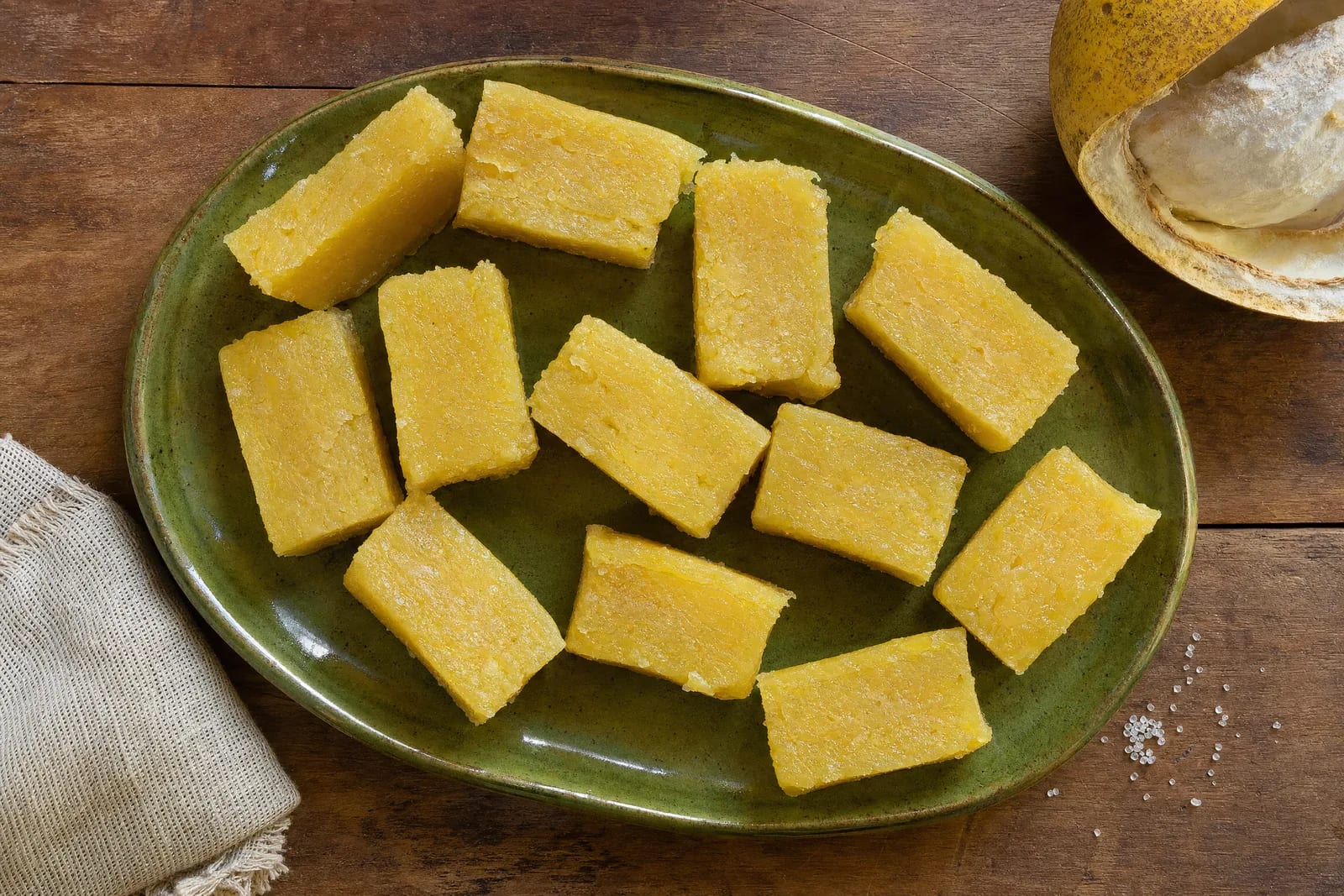
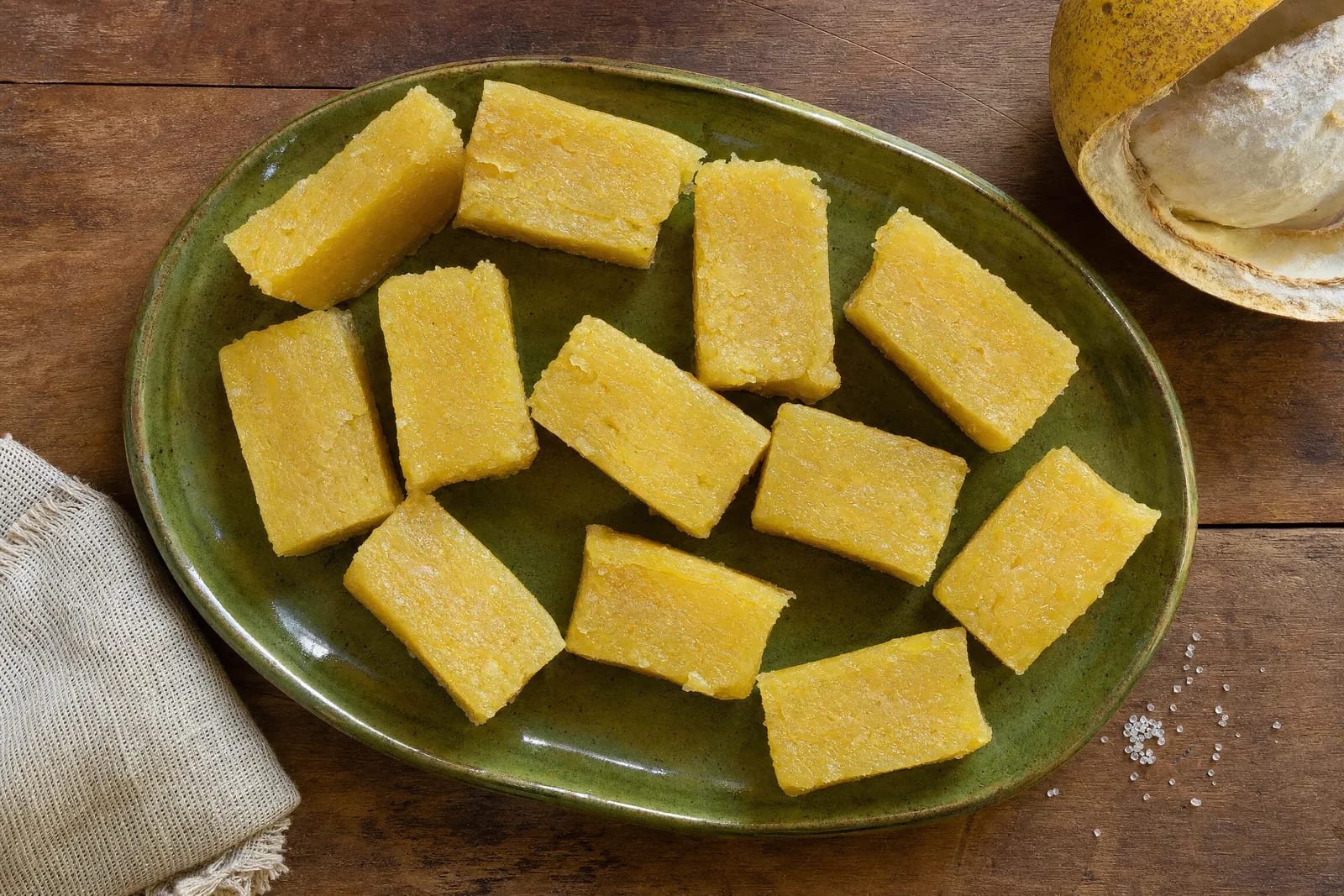
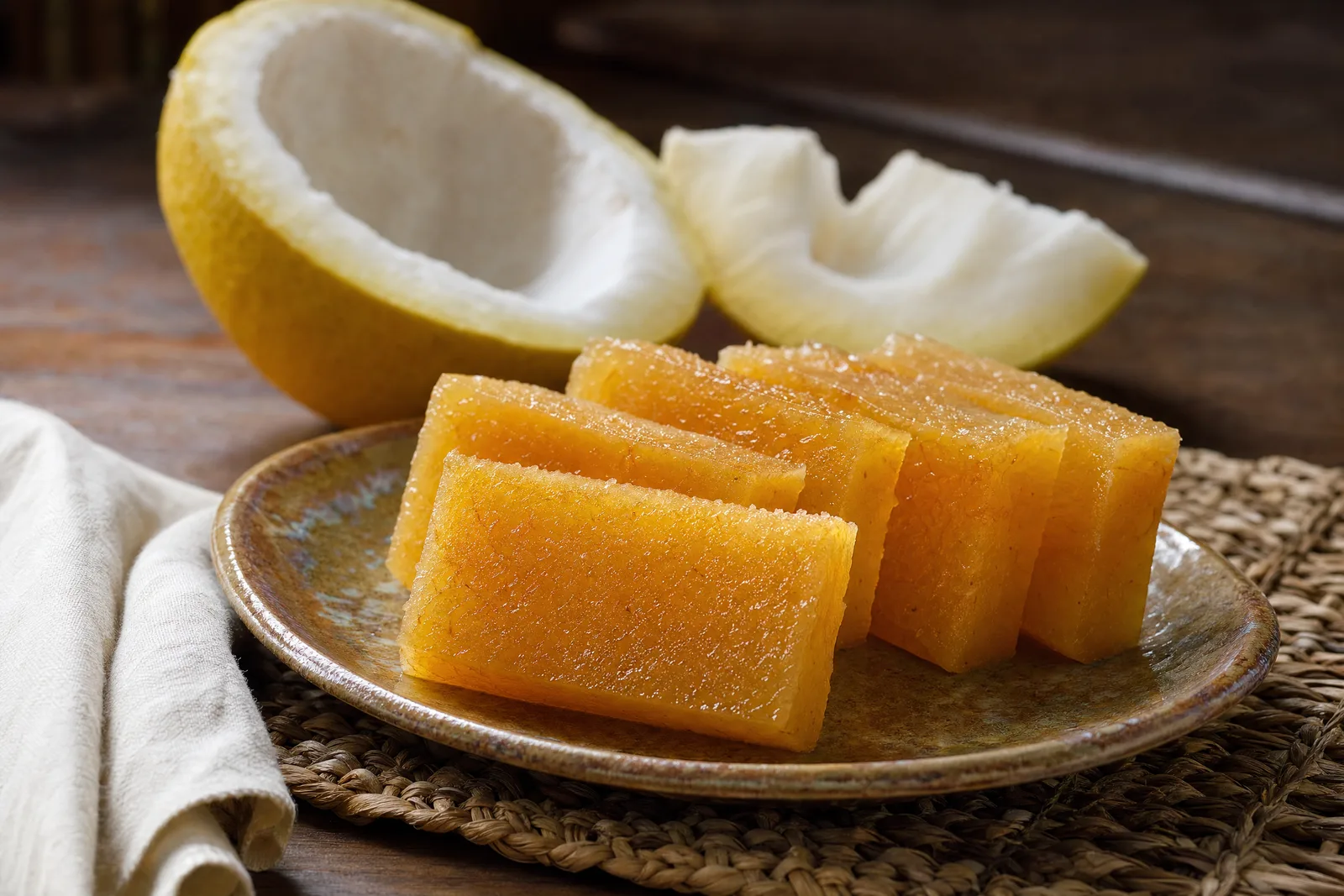
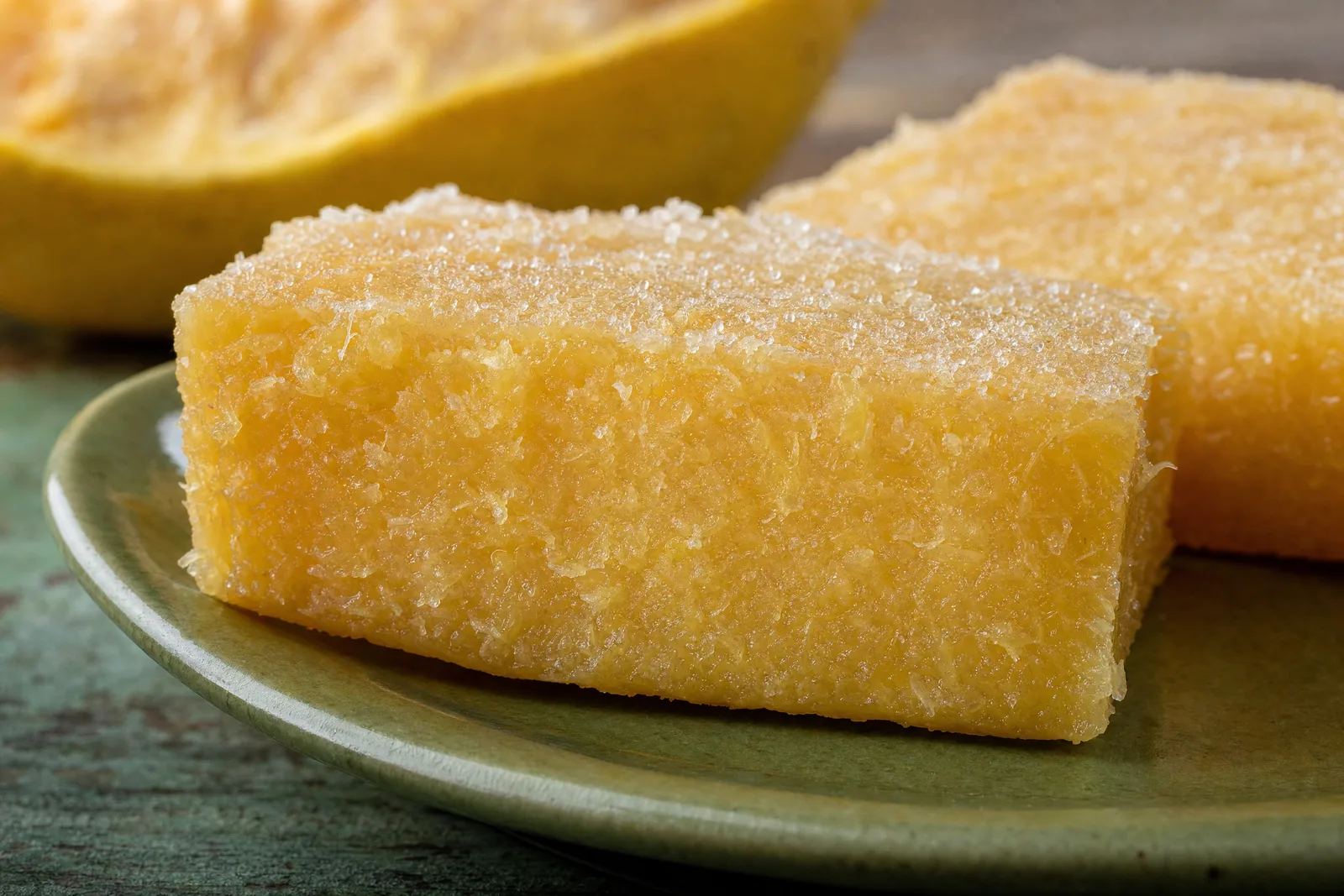
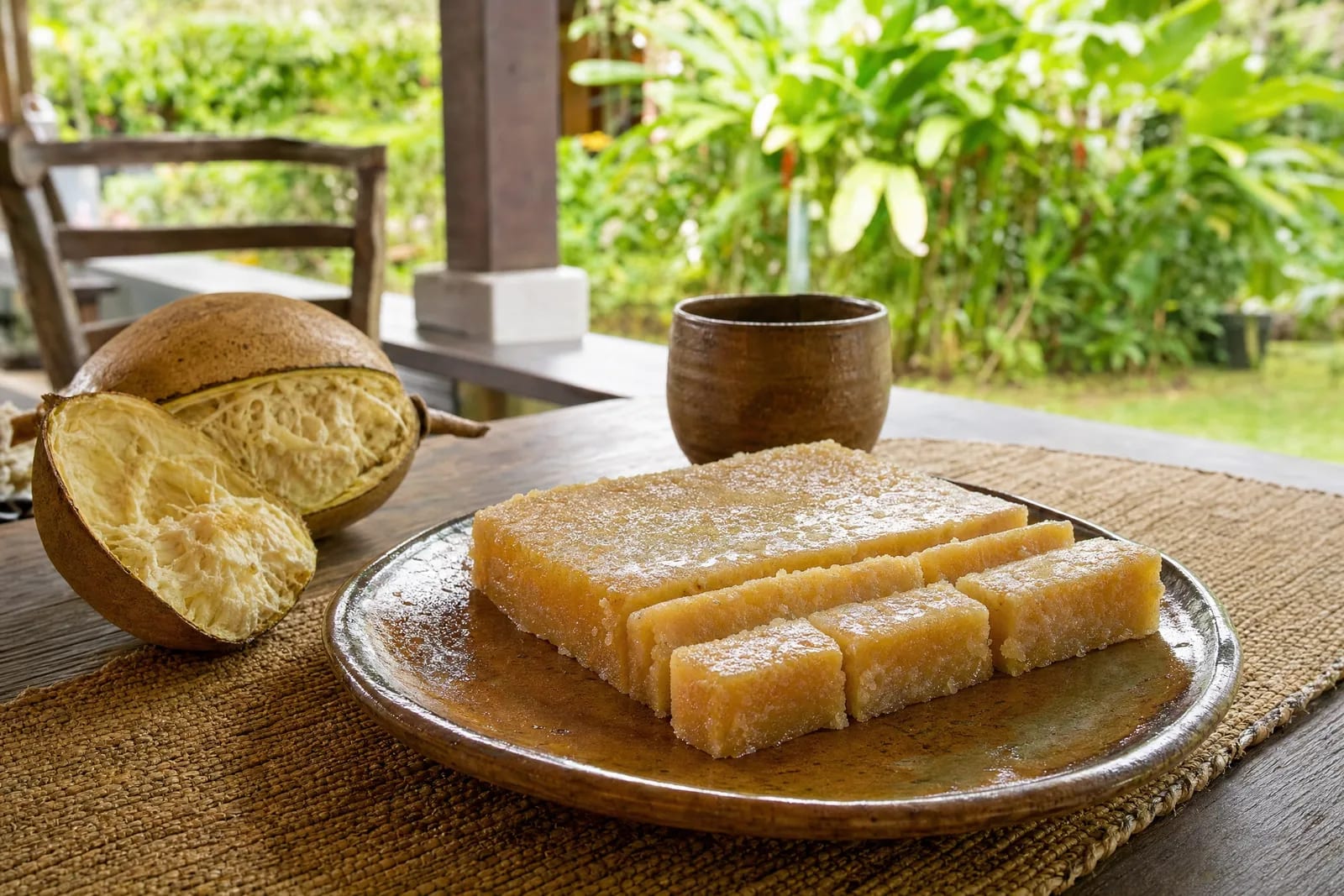
In Pará, bacuri — a fragrant Amazonian fruit — is prized for its pulp and generous peel. In this sliceable doce de bacuri, the cooked inner layer of the peel meets sugar and gentle heat until it becomes a firm paste meant to be shared at the table.
Behind the flavor
Bacuri belongs to the landscape of Amazonian backyards, markets, and extractive harvesting; in Pará, its pulp goes into sweets, juices, and ice cream. Making this sweet with the inside of the peel extends the fruit beyond its pulp, bringing home cooking closer to a tradition of using every part that also appears in Marajó. It is a fruit dessert, but also a gesture of care toward the forest’s raw materials.
📜 Ingredients
- •ripe bacuri peel1.2 kg (2.6 lb), yielding about 500 g (18 oz) of cooked inner layer🔁 ripe mango pulp — Mango can make a firm fruit sweet, but it loses bacuri’s resinous acidity and identity.
- •drinking water2 liters (8 cups) for boiling, plus 480 ml (2 cups) for blending
- •granulated sugar250 g (9 oz)
👨🍳 Method
- 1
Wash the bacuri peels, cut them into large pieces, and cover them with water in a saucepan. Boil for 8–10 minutes, discard the water, and repeat twice more, always using fresh water.
The three boils help reduce the natural resin. If it clings to the pan, let it cool slightly, wipe it with paper towel and a little oil, then wash as usual.
- 2
Cover the peels again with clean water and cook over medium heat for 25–35 minutes, until the inner layer is very soft, like a thoroughly cooked potato. Drain, let cool slightly, and remove the outer skin with the knife.
Weigh out 500 g (18 oz) of the cooked inner layer; refrigerate the rest for up to 2 days for another batch.
- 3
Blend the 500 g (18 oz) of cooked inner layer with 480 ml (2 cups) of water until smooth. Transfer to a heavy-bottomed saucepan, add the granulated sugar, and stir before turning on the heat.
The blender only smooths the mixture; do not add more water if the cream is already fluid.
- 4
Cook over low heat for 18–25 minutes, stirring constantly with the spatula, until it reaches the sliceable-sweet stage: the mixture will be thick, leave a path across the bottom of the pan, and take a moment to come together again.
Place a small portion on a chilled plate; once it cools slightly, it should hold its shape without running.
- 5
Pour the doce de bacuri into a lightly moistened baking dish, smooth the surface, and let cool. Refrigerate for at least 2 hours before cutting into squares or serving by the spoonful. In Marajó, doce de bacuri is also served with water buffalo milk cheeses.
Keep refrigerated in a covered container for up to 5 days.
🥃 Pairing
With cachaça
Cachaça from an Abaetetuba alambique, white or briefly aged
Clean, soft, and lightly sweet.
Pará’s alambique tradition can open the pairing without concealing bacuri’s fragrant acidity; serve a small, chilled measure.
Amburana-aged cachaça
Cinnamon, vanilla, and sweet wood.
Warm wood notes round out the sugar and echo the sweet’s tropical perfume; it is an option for serving after dessert.
Also pairs well with
✈️ A flavor worth the trip
If bacuri is in season, buy the whole fruit and explore its aroma before cooking: it is a rare discovery, far from the logic of standardized fruit. In Belém and throughout Pará’s interior, ask the fruit sellers about the origin of that batch and how to use the peel.
💡 Quick tips
- •Use very ripe bacuri: the peel should be intact, while the interior must yield to cooking without turning fibrous.
- •Do not rush the setting point with high heat; the sugar may caramelize before the mixture loses water evenly.
- •For a thinner slice, spread the sweet while hot in a larger baking dish; to serve by the spoonful, turn off the heat just before the sliceable-sweet stage.
🤔 Did you know?
Embrapa notes that bacuri yields pulp used in ice cream, sweets, juices, and other products. Research has also evaluated the fruit’s peel as a raw material for fruit paste, lending technical support to a use the Amazonian kitchen already knows well.
Small discoveries
- Bacuri · ingredient
- An Amazonian fruit of the species Platonia insignis, with a thick peel and distinctly fragrant pulp.
- Doce de cortar · technique
- The cooking stage at which the sugared mixture gains enough structure to cool, set, and be sliced.
- Marajó · cultural expression
- A large river-and-sea island in Pará, known for water buffalo farming, its cheeses, and landscapes of rivers and tides.
📚 References
- EMBRAPA. HOMMA, Alfredo Kingo Oyama; CARVALHO, José Edmar Urano de; MENEZES, Antonio José Elias A. de. Bacuri: fruta amazônica em ascensão. Ciência Hoje, 2010. Disponível em: https://www.alice.cnptia.embrapa.br/alice/handle/doc/872367
- EMBRAPA AMAZÔNIA ORIENTAL; UNIVERSIDADE DO ESTADO DO PARÁ. XAVIER, J. M. Q.; FERREIRA, M. F.; MATIETTO, R. A. Avaliação do uso de conservantes em doce em pasta obtido a partir da casca do fruto bacuri. Disponível em: https://www.alice.cnptia.embrapa.br/alice/bitstream/doc/409405/1/2082.pdf
- RIGO, Neide. Bacuri da Ilha do Marajó vira doce de cortar. Come-se, 2010. Disponível em: https://come-se.blogspot.com/2010/03/bacuri-da-ilha-do-marajo-vira-doce-de.html
Keep discovering